
Meet the 9 GHS hazard pictograms
Nine diamonds, the same meaning the world over. They appear on packaging with dangerous contents and are laid down in the United Nations GHS system and the European CLP regulation. Here is what each one means — and which official warning statements go with it.
One diamond, one meaning, everywhere
A pictogram is not a picture a manufacturer picks. Which symbol goes on a package follows from how the substance is classified — and that same classification decides which warning statement, the H-statement, appears on the label. So every pictogram comes with a fixed list of H-statements. Know the nine diamonds and you know, for any bottle you pick up, which corner the danger is in — even when you cannot read the language on the label.
-
 GHS01
GHS01
Explosive
Ontplofbaar
This substance can go off in one blow — from a knock, from friction, from a spark, or simply from heat. Whatever is around it goes with it. The same symbol appears on substances that decompose when heated and can then still explode.
Official name: Exploding bomb
7 Show the H-statements
Official H-statements for this pictogram
- H200
- Unstable explosives.
- H201
- Explosive; mass explosion hazard.
- H202
- Explosive, severe projection hazard.
- H203
- Explosive; fire, blast or projection hazard.
- H204
- Fire or projection hazard.
- H240
- Heating may cause an explosion.
- H241
- Heating may cause a fire or explosion.
-
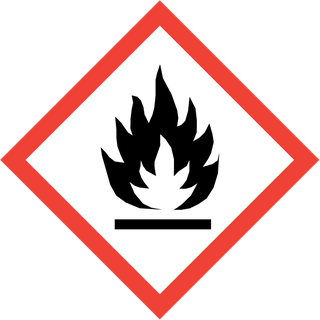 GHS02
GHS02
Flammable
Ontvlambaar
Anything that catches fire easily: gases, aerosols, liquids and their vapours, and solids. Some do not even need a spark — they ignite the moment they meet air, or they release flammable gas as soon as they get wet.
Official name: Flame
18 Show the H-statements
Official H-statements for this pictogram
- H206
- Fire, blast or projection hazard; increased risk of explosion if desensitising agent is reduced.
- H207
- Fire or projection hazard; increased risk of explosion if desensitising agent is reduced.
- H208
- Fire hazard; increased risk of explosion if desensitising agent is reduced.
- H220
- Extremely flammable gas.
- H222
- Extremely flammable aerosol.
- H223
- Flammable aerosol.
- H224
- Extremely flammable liquid and vapour.
- H225
- Highly flammable liquid and vapour.
- H226
- Flammable liquid and vapour.
- H228
- Flammable solid.
- H232
- May ignite spontaneously if exposed to air.
- H241
- Heating may cause a fire or explosion.
- H242
- Heating may cause a fire.
- H250
- Catches fire spontaneously if exposed to air.
- H251
- Self-heating: may catch fire.
- H252
- Self-heating in large quantities; may catch fire.
- H260
- In contact with water releases flammable gases which may ignite spontaneously.
- H261
- In contact with water releases flammable gases.
-
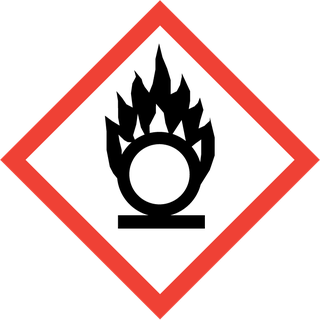 GHS03
GHS03
Oxidizing
Oxiderend
This substance does not burn itself, but it gives off oxygen. That makes an existing fire far fiercer, and gets things burning that would not burn on their own. Which is exactly why this is the pictogram people misread most often.
Official name: Flame over circle
3 Show the H-statements
Official H-statements for this pictogram
- H270
- May cause or intensify fire; oxidiser.
- H271
- May cause fire or explosion; strong oxidiser.
- H272
- May intensify fire; oxidiser.
-
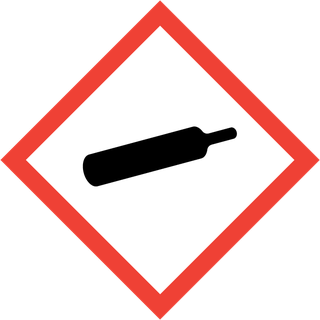 GHS04
GHS04
Gas under pressure
Gas onder druk
The contents are under high pressure, or chilled so far that they stay liquid. If the container warms up, it can burst. Refrigerated gas causes cryogenic burns the moment it touches your skin.
Official name: Gas cylinder
2 Show the H-statements
Official H-statements for this pictogram
- H280
- Contains gas under pressure; may explode if heated.
- H281
- Contains refrigerated gas; may cause cryogenic burns or injury.
-
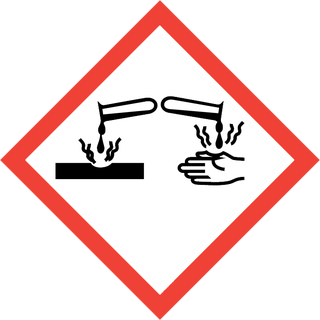 GHS05
GHS05
Corrosive
Bijtend
This substance eats into whatever it lands on: your skin, your eyes, and sometimes metal too. Eye damage can be permanent, and it happens faster than you can rinse.
Official name: Corrosion
3 Show the H-statements
Official H-statements for this pictogram
- H290
- May be corrosive to metals.
- H314
- Causes severe skin burns and eye damage.
- H318
- Causes serious eye damage.
-
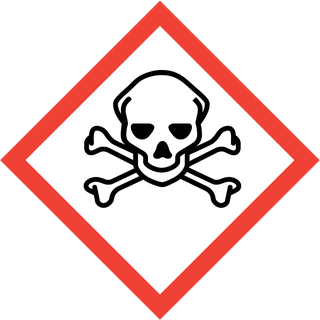 GHS06
GHS06
Toxic
Giftig
A small amount is enough to make someone seriously ill, or worse. How it gets in makes no difference: swallowing, through the skin, or breathing it in — all three routes sit under this one pictogram.
Official name: Skull and crossbones
6 Show the H-statements
Official H-statements for this pictogram
- H300
- Fatal if swallowed.
- H301
- Toxic if swallowed.
- H310
- Fatal in contact with skin.
- H311
- Toxic in contact with skin.
- H330
- Fatal if inhaled.
- H331
- Toxic if inhaled.
-
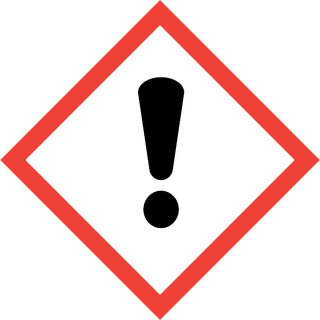 GHS07
GHS07
Health hazard
Gezondheidsgevaar
The mildest of the health pictograms, and for that very reason the most underestimated. It covers irritation of skin, eyes or airways, allergic reactions, drowsiness or dizziness, and substances that are harmful without being deadly. It also appears on substances that damage the ozone layer.
Official name: Exclamation mark
9 Show the H-statements
Official H-statements for this pictogram
- H302
- Harmful if swallowed.
- H312
- Harmful in contact with skin.
- H315
- Causes skin irritation.
- H317
- May cause an allergic skin reaction.
- H319
- Causes serious eye irritation.
- H332
- Harmful if inhaled.
- H335
- May cause respiratory irritation.
- H336
- May cause drowsiness or dizziness.
- H420
- Harms public health and the environment by destroying ozone in the upper atmosphere
-
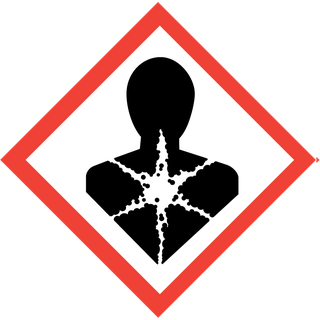 GHS08
GHS08
Serious health hazard
Ernstig gezondheidsgevaar
Harm you usually only notice much later: to your organs, your lungs, your DNA, your fertility or an unborn child. Substances that can cause cancer carry this symbol too, and substances that are fatal if you choke on them and they reach your lungs.
Official name: Health hazard
12 Show the H-statements
Official H-statements for this pictogram
- H304
- May be fatal if swallowed and enters airways.
- H334
- May cause allergy or asthma symptoms or breathing difficulties if inhaled.
- H340
- May cause genetic defects
- H341
- Suspected of causing genetic defects
- H350
- May cause cancer
- H351
- Suspected of causing cancer
- H360
- May damage fertility or the unborn child
- H361
- Suspected of damaging fertility or the unborn child
- H370
- Causes damage to organs
- H371
- May cause damage to organs
- H372
- Causes damage to organs through prolonged or repeated exposure
- H373
- May cause damage to organs through prolonged or repeated exposure
-
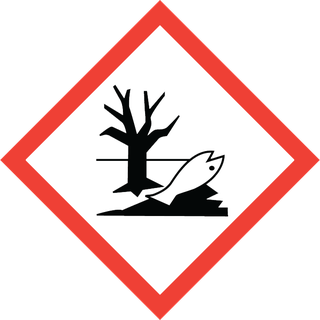 GHS09
GHS09
Environmental hazard
Milieugevaar
This pictogram is not about you, but about what happens when the substance ends up in water, soil or the drain. Harmful to everything living in water, often with effects that last a long time.
Official name: Environment
3 Show the H-statements
Official H-statements for this pictogram
- H400
- Very toxic to aquatic life.
- H410
- Very toxic to aquatic life with long lasting effects.
- H411
- Toxic to aquatic life with long lasting effects.
The H-statements on this page are taken verbatim from the official CLP texts, linked to the pictograms following the ECHA guidance "Guidance on Labelling and Packaging", version 4.1 (May 2020), section 7.3. For a number of statements the supplier fills in more on the label — the route of exposure or the organ affected; that addition is not shown here.
What the pictograms do not tell you
A pictogram says which corner the danger is in, not how severe it is, and certainly not what to do about it. Two products carrying the same diamond can be far apart. That difference sits in the H-statement beside it, in the signal word — "Danger" outranks "Warning" — and in the safety data sheet, which sets out per product what the hazards are and how to protect yourself.
Not every warning gets a pictogram
Some H-statements appear on a label with no diamond of their own. H412 and H413, for instance, about long-lasting harm to aquatic life, or H362, about substances that may harm a breast-fed child. So no pictogram does not mean no risk. Read the statements without a picture too.
Two names deliberately depart from the official CLP wording: in this game GHS07 is called "Health hazard" (officially: Exclamation mark) and GHS08 "Serious health hazard" (officially: Health hazard). The underlying classification is unchanged; these names were chosen because they are clearer for children and non-specialists. The official name is shown with each pictogram.
Where this data comes from
The classification and the warning statements on this page are not ours. Regulation (EC) No 1272/2008 — the CLP Regulation — lays down which pictogram belongs to which hazard class and how each H-statement reads. The European Chemicals Agency (ECHA) publishes the accompanying guidance on labelling and packaging.
Your own edition for your organisation?
Your logo on every card, situations from your own sector, your own box. Request a proposal, no obligations.